Notes for New Customers
Please read all the information below and call us if you have any questions!
How the Business Works
• Good Libations is not a wine store or a winery; hence, we cannot sell bottled products. Each wine that you order is considered to be your own project. We can help, but you have certain obligations that we are not allowed to circumvent:
(1) You must be there, in person, to start your wine. You may not place an order over the phone or the internet.
(2) You are required to sign an order and pay for it at the same time (credit card, debit card, cash, or cheque).
(3) You must be present to bottle your wine. A standard batch of wine is 30 bottles.
Group projects, in which a batch is divided among several people, can be organized by you. Ask us for more information.
• Standard wines are bottled on Wednesdays and carbonated products on Saturdays. The set-up, take-down, and clean-up are major projects, and there is only one work space on the premises, so we do this for efficiency’s sake.
Seasonal Projects
• During the fruit season, we offer a variety of fruit wines and ciders, including apricot, peach, blueberry, rhubarb, strawberry, and raspberry, wherein we provide the fruit.
• Wine can also be made from fruit that you provide.
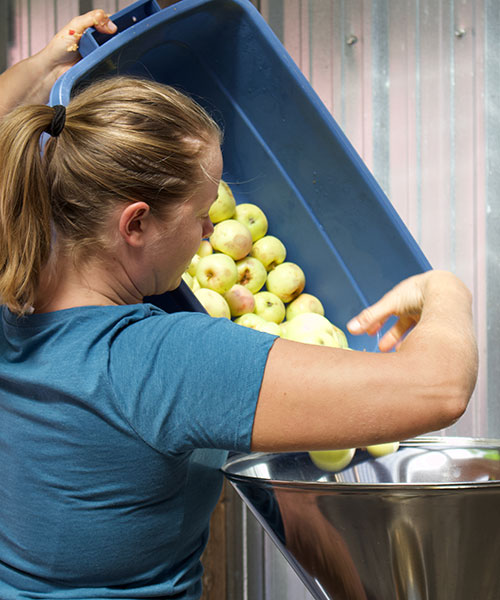
• If you have apples, we can press the juice from them, and this can be made into wine or cider; or, you can take away the fresh juice.
• No apples? No problem. We can provide you with juice through our Food Bank support program. Please ask us about this, if you would like more details.
Bottles
• The cost of bottles is not included in the price of the wine. You may either bring your own or purchase new ones from us.
• Alternately, for the price of the deposit, you can acquire bottles (that have been returned by customers) from local stores; these bottles must be cleaned really well.
Cleaning Bottles
• It is very important that you rinse your bottles in hot water several times as soon as you empty them, or at least fill them with water until you can do this later. Do not let them sit empty and unrinsed, even for an hour. This is especially important for bottles that will be filled with a carbonated beverage. If you are diligent about this, bottles can be used multiple times without further cleaning; if you are not, cleaning your bottles can become a major project.
• Allow your bottles to dry thoroughly before putting them away so that mold and algae do not grow inside them.
Appointment Times
• Bottlings are by appointment only, and we will set up a bottling time for you when your wine or cider is ready. We make every effort to accommodate your schedule when booking a time. Please be on time for your appointment, as our bottling schedules are often very tight.
Caring for Your Wine
• Newly bottled wine experiences bottle shock. When you bottle, oxygen is introduced into your wine. Your wine will not oxidize because you bottled—indeed, it will help in maturing it—but your wine needs to get over the shock of being transferred and will be working to reach a new equilibrium. There is no set time period for bottle shock, but during this time, your wine will taste somewhat flat and listless. Many variables affect the equilibrium process, but it is accepted that after 8-12 weeks, the bottle shock will subside. If your wine is heavy with tannins, the bottle shock recovery time will be even longer.
• Leave your full bottles upright for three days after they have been corked, then put them on their sides to keep the corks moist; otherwise, the corks may dry out and let in unwanted air.
• Keep your wine in a dark place. Light excites molecules and oxidizes the wine.
• Maintain a constant temperature in your storage location (between 14oC and 16oC). This prevents your wine from ageing prematurely. Rapid temperature changes are detrimental to your wine.
• Keep your wine in a place that is between 50% and 80% humidity. Anything below 50% may result in the corks drying out. Once the corks dry out, air enters the bottles, and spoilage occurs.
• It is natural for wines (especially full-bodied reds) to shed some tannin during ageing. Do not store your wine on top of a refrigerator, next to laundry equipment, or under stairs, as vibrations can cause wine sediments to stay suspended, creating either a haze or “floaties.”
• When storing your wine, keep it away from odoriferous products. Corks are designed to breathe, and paint or other chemical odours may enter your wine bottles and taint your wine.
• The above notes on caring for your wine are suggestions only. They are goals to reach for, but if you cannot manage all of them, don’t worry; just do your best.
Ageing Your Wine
• Your wine needs to be aged in order for the flavours to blend and mellow. Fresh or “green” wines have a harshness that will soften over time. The difference is quite remarkable and well worth the patience required. Ideally, red wines should be aged for a year and white wines for six months.